You'll see the words reconstituted lapis on some of my pieces. I'd rather explain it than leave you guessing, so here's exactly what it is.
First, genuine lapis
Lapis lazuli is a deep blue stone that's been prized for thousands of years. Solid lapis is cut straight from the rock, often with little gold-colored flecks of pyrite and streaks of white. When I use solid lapis, I call it genuine lapis.

Genuine lapis: solid stone, cut from the rock.
So what's reconstituted lapis?
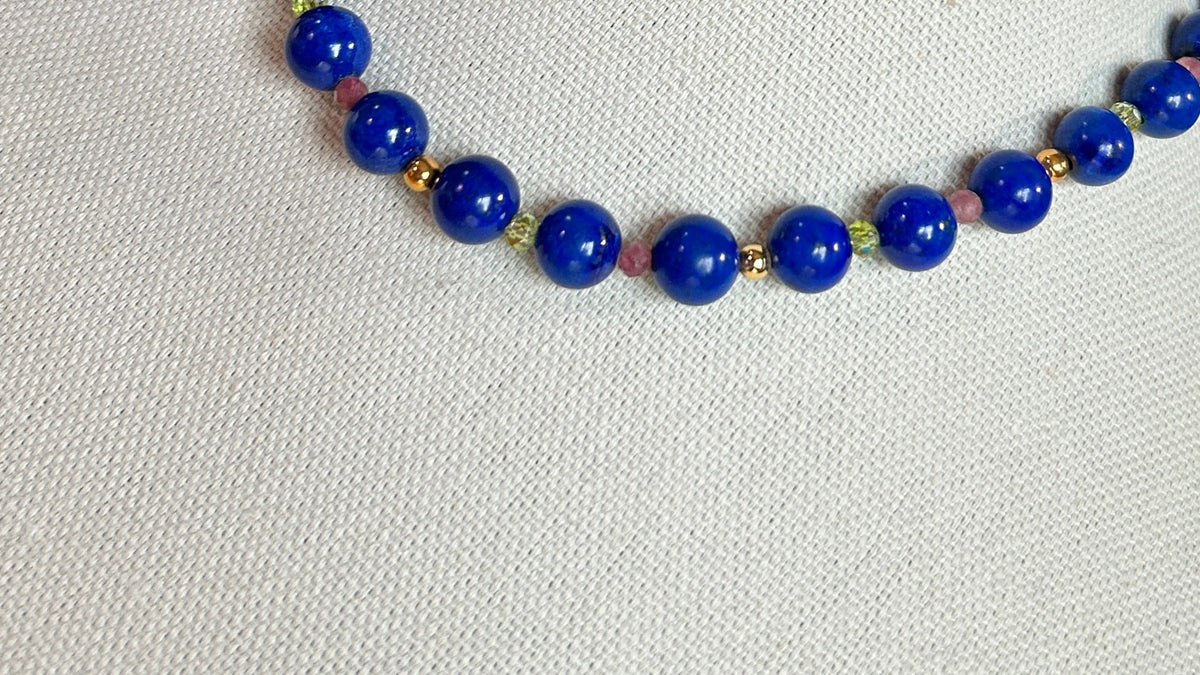
Reconstituted lapis starts with real lapis, in small pieces or powder too little to cut into beads on their own. Those bits are bonded together with resin, pressed into a block, and then cut and shaped like any other stone. The color is sometimes enhanced along the way.
The result is a bead with lapis in it and that rich, inky blue, at a price that lets a statement piece stay a statement piece instead of a splurge.

That deep blue base? Reconstituted lapis, on my Howlite & Reconstituted Lapis Fish Necklace.
Genuine, reconstituted or faux?
- Genuine lapis: solid stone, cut from the rock.
- Reconstituted lapis: real lapis pieces bonded with resin and shaped into beads.
- Faux or imitation lapis: made to look like lapis without containing any, such as glass or dyed stone.
How I label it
On my site, lapis means reconstituted lapis unless the listing says genuine lapis. If a piece is solid stone, I'll say so, right in the listing.
How to care for it
Because reconstituted lapis has resin in it, it likes a gentle touch:
- Put it on after perfume, lotion and hairspray, not before.
- Keep it away from high heat and harsh cleaners.
- Wipe it with a soft, dry cloth instead of soaking it.
- Store it on its own so harder beads don't scratch it.
Questions about a stone in one of my pieces? Email me at tammy@trandalljewelry.com. I'll tell you exactly what it is.